

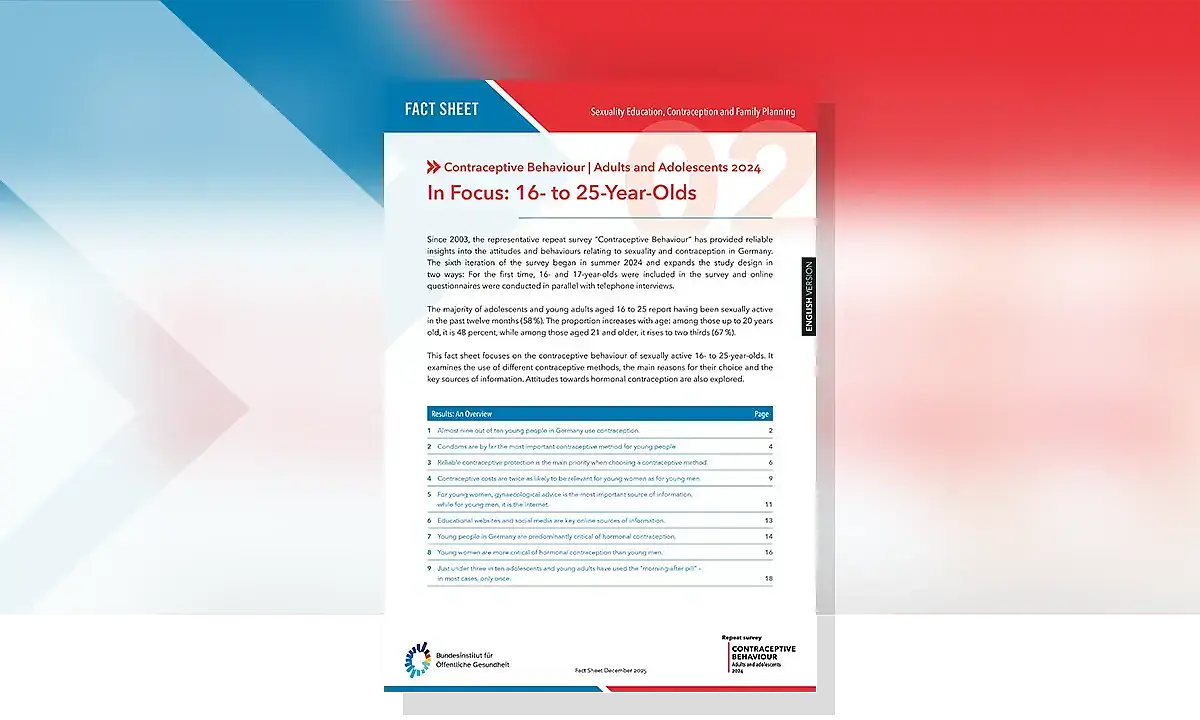
Since 2003, the representative repeat survey “Contraceptive Behaviour” has provided reliable insights into the attitudes and behaviours relating to sexuality and contraception in Germany. The sixth iteration of the survey began in summer 2024 and expands the study design in two ways: For the first time, 16- and 17-year-olds were included in the survey and online questionnaires were conducted in parallel with telephone interviews.
The majority of adolescents and young adults aged 16 to 25 report having been sexually active in the past twelve months (58 %). The proportion increases with age: among those up to 20 years old, it is 48 percent, while among those aged 21 and older, it rises to two thirds (67 %).
This fact sheet focuses on the contraceptive behaviour of sexually active 16- to 25-year-olds. It examines the use of different contraceptive methods, the main reasons for their choice and the key sources of information. Attitudes towards hormonal contraception are also explored.
Results: An overview
- Almost nine out of ten young people in Germany use contraception.
- Condoms are by far the most important contraceptive method for young people.
- Reliable contraceptive protection is the main priority when choosing a contraceptive method.
- Contraceptive costs are twice as likely to be relevant for young women as for young men.
- For young women, gynaecological advice is the most important source of information, while for young men, it is the internet.
- Educational websites and social media are key online sources of information.
- Young people in Germany are predominantly critical of hormonal contraception.
- Young women are more critical of hormonal contraception than young men.
- Just under three in ten adolescents and young adults have used the "morning-after pill" – in most cases, only once.