

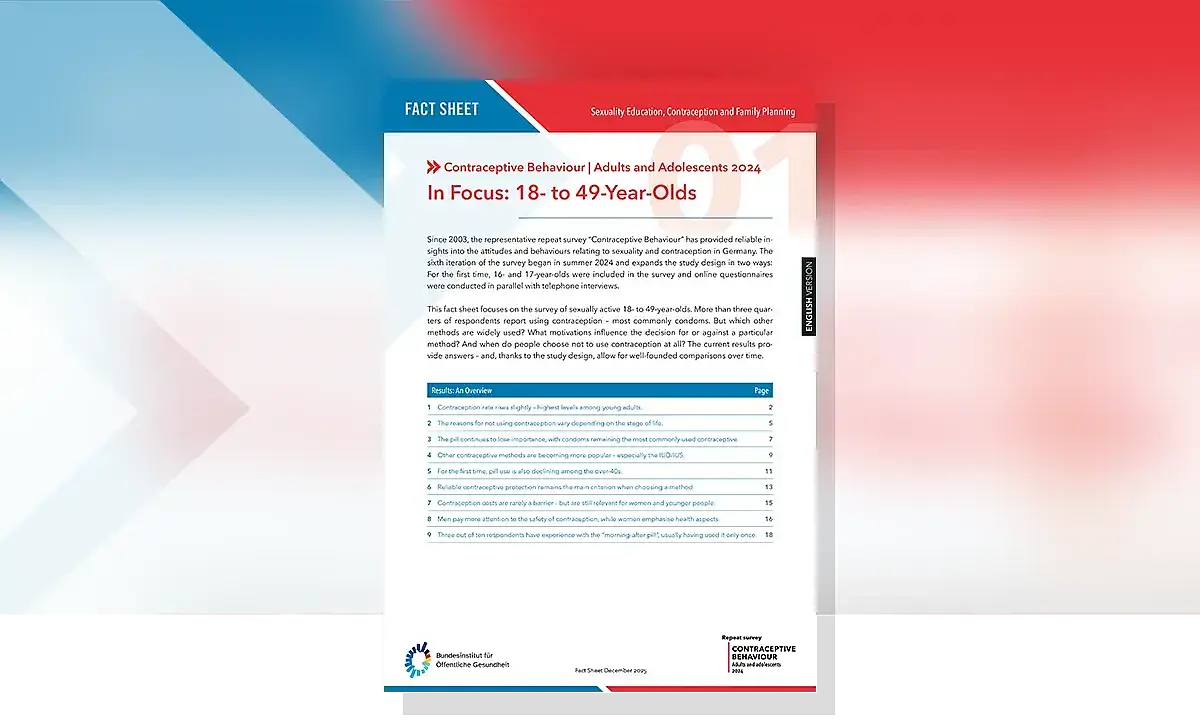
Since 2003, the representative repeat survey "Contraceptive Behaviour" has provided reliable insights into the attitudes and behaviours relating to sexuality and contraception in Germany. The sixth iteration of the survey began in summer 2024 and expands the study design in two ways: For the first time, 16- and 17-year-olds were included in the survey and online questionnaires were conducted in parallel with telephone interviews.
This fact sheet focuses on the survey of sexually active 18- to 49-year-olds. More than three quarters of respondents report using contraception – most commonly condoms. But which other methods are widely used? What motivations influence the decision for or against a particular method? And when do people choose not to use contraception at all? The current results provide answers – and, thanks to the study design, allow for well-founded comparisons over time.
Results: An overview
- Contraception rate rises slightly – highest levels among young adults.
- The reasons for not using contraception vary depending on the stage of life.
- The pill continues to lose importance, with condoms remaining the most commonly used contraceptive.
- Other contraceptive methods are becoming more popular – especially the IUD/IUS.
- For the first time, pill use is also declining among the over-40s.
- Reliable contraceptive protection remains the main criterion when choosing a method.
- Contraception costs are rarely a barrier – but are still relevant for women and younger people.
- Men pay more attention to the safety of contraception, while women emphasise health aspects
- Three out of ten respondents have experience with the "morning-after pill", usually having used it only once