

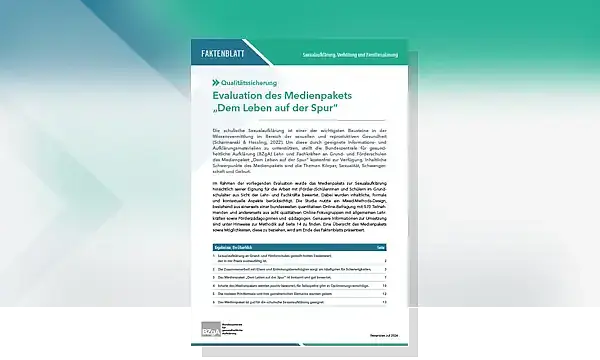
Die schulische Sexualaufklärung ist einer der wichtigsten Bausteine in der Wissensvermittlung im Bereich der sexuellen und reproduktiven Gesundheit (Scharmanski & Hessling, 2022). Um diese durch geeignete Informations- und Aufklärungsmaterialien zu unterstützen, stellt dasBundesinstitut für Öffentliche Gesundheit (BIÖG, vormals BZgA) Lehr- und Fachkräften an Grund- und Förderschulen das Medienpaket „Dem Leben auf der Spur“ kostenfrei zur Verfügung. Inhaltliche Schwerpunkte des Medienpakets sind die Themen Körper, Sexualität, Schwangerschaft und Geburt.
Im Rahmen der vorliegenden Evaluation wurde das Medienpaket zur Sexualaufklärung hinsichtlich seiner Eignung für die Arbeit mit (Förder-)Schülerinnen und Schülern im Grundschulalter aus Sicht der Lehr- und Fachkräfte bewertet. Dabei wurden inhaltliche, formale und kontextuelle Aspekte berücksichtigt. Die Studie nutzte ein Mixed-Methods-Design, bestehend einerseits aus einer bundesweiten quantitativen Online-Befragung mit 570 Teilnehmenden und andererseits aus acht qualitativen Online-Fokusgruppen mit allgemeinen Lehrkräften sowie Förderpädagoginnen und -pädagogen. Genauere Informationen zur Umsetzung sind unter Hinweise zur Methodik auf Seite 14 zu finden. Eine Übersicht des Medienpakets sowie Möglichkeiten, dieses zu beziehen, wird am Ende des Faktenblatts präsentiert.
Die zentralen Ergebnisse im Überblick:
- Sexualaufklärung an Grund- und Förderschulen genießt hohen Stellenwert, der in der Praxis ausbaufähig ist.
- Die Zusammenarbeit mit Eltern und Erziehungsberechtigten sorgt am häufigsten für Schwierigkeiten.
- Das Medienpaket „Dem Leben auf der Spur“ ist bekannt und gut bewertet.
- Inhalte des Medienpakets werden positiv bewertet, für Teilaspekte gibt es Optimierungsvorschläge.
- Die meisten Printformate und ihre gestalterischen Elemente werden gelobt.
- Das Medienpaket ist gut für die schulische Sexualaufklärung geeignet.